FOR DEVICES AND SCREENS

Beautiful screens, no graphics card.

Aster draws every pixel on the processor. Your device needs an operating system and a screen, not a graphics card or its drivers.

Software 3D heroDrawn by Aster

Why it fits a device

Less to install, less to break.

No graphics card needed

Every frame is drawn on the processor, so there are no graphics drivers to bring up.

A graphics card is optional. The processor is the default, and the fallback.

Runs on a small ARM box

A streaming box with four 32-bit ARM cores runs Aster on its processor.

Checked on the device itself, with Android 14.

Almost nothing to install

On Linux it links only the C runtime. Fonts are built in, so the device needs no font setup.

A program with just the drawing core is 1.5 MB.

Quiet when nothing moves

A still screen asks for no frames, and a change redraws only the pixels it touches.

Idle: 0.0024 % of one processor core, in our Linux check.

How it reaches your screen

  • One codebase for Linux, Windows 11 and Android (TV, native), plus the web via wasm. Android phone apps are not tested.
  • On Linux it opens its own window on X11 or Wayland. On Android it fills the app's window.
  • Own display? From Rust, take each frame's pixels and copy only the changed parts.
  • From C: describe the screen as JSON and get events back. Any thread can push new values.
3 more ways it fits
  • A remote or D-pad moves focus to the nearest control on screen.
  • Screens can ask what they're on, from a 320 by 240 strip to a portrait sign or a TV.
  • Test every screen on a build server with no display: press buttons by name, read back every label, save a picture.
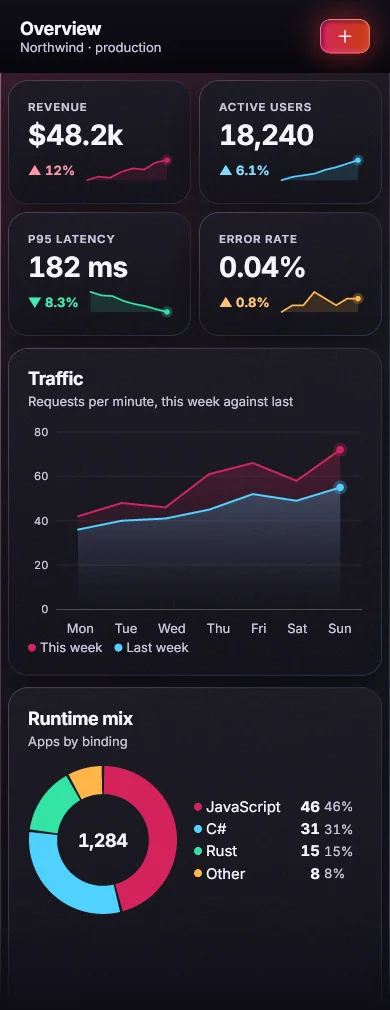
The Northwind dashboard in its phone layout, drawn by Aster.Drawn by Aster

Where it could fit (illustrative)

Read 3 short examples

A TV box app

A small Android app hands Aster its window, and the remote moves focus around the shelves. The team keeps full-screen glow and smoke for bigger chips.


A machine status panel

A control loop on its own thread pushes new readings, and Aster redraws only the numbers that changed. When the line stops, the screen rests too.

A lobby sign

A small C program writes today's schedule as JSON and Aster shows it on a portrait screen. Nothing is redrawn until the schedule changes.

Good to know

  • Not for microcontrollers. Aster needs an operating system and tens of megabytes of memory. For chips with kilobytes, look at toolkits made for microcontrollers.
  • 64-bit ARM builds have not been run, and there are no Raspberry Pi results.
3 more to know
  • Full-screen glow, glass and smoke are slow on small ARM chips. Keep them small there.
  • On Linux, Aster's own window needs X11 or Wayland and does not pass touch. To draw straight to a display, write a small host in Rust.
  • Not certified for safety-critical use. Aster is still before 1.0, so names can change.