

Why Aster

Claims you can check

Each claim below names the file in the repository that proves it: a test, a tool or a measured record, with the result and how to check it. Paths are relative to the engine repository's root.

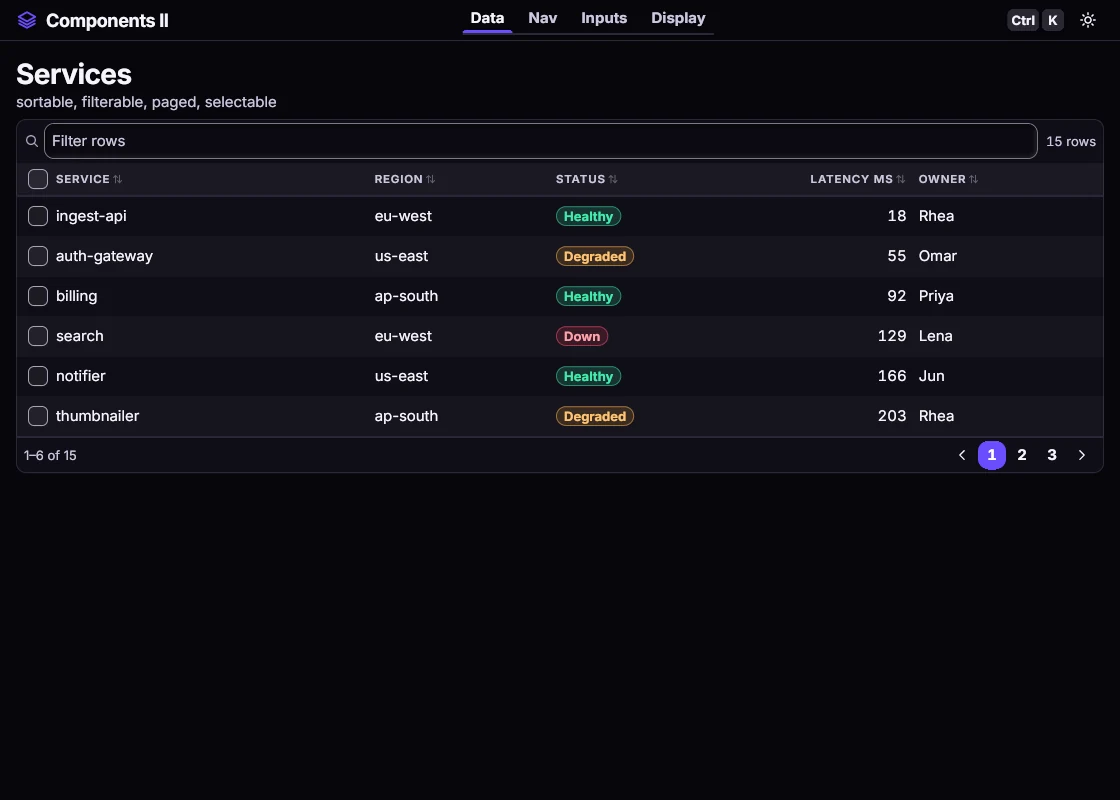
Sortable, filterable data tableDrawn by Aster

How to read a claim

verified
checked by running the named test, script or tool (15)
partial
works, with recorded open items (1)
pending
a stated check is not yet in place (1)
verified

Byte-exact, deterministic CPU rendering

The same scene produces the same pixels every time, on every platform we have compared: native and WebAssembly agree bit for bit.

Result, method and evidence

Result: for eight scripted workloads (settings screen, hover, typing, scrolling chat, fluid smoke, theme cross-fade, charts, cinematic effects) at two sizes, 976 of 976 frames hash identically between the native renderer and two WebAssembly builds (scalar and simd128). The first 1920x1080 charts frame has the same SHA-256 on all three (8023bc0c...f6b4). Separately, 125 PNGs from 18 of the repository's example programs were rendered twice and compared: 0 differences.

Method: every frame is hashed (FNV-1a-64 of the RGBA buffer) and compared against the native oracle, run under Node/V8; the spot check compares raw RGBA SHA-256.

Scope: CPU rendering with the shipped fonts; this is not a claim about GPUs or about other CPU architectures than the ones tested. Measured 2026-11-11.

Check it Licensed source customers: run web/tools/check-wasm-exact.sh. Binary customers: render the same scene with the native runtime and the wasm module and compare SHA-256 of the RGBA output (see WebAssembly guide).

Evidence in the repository

  • web/tools/check-wasm-exact.mjsframe-by-frame comparison against the native oracle
  • web/README.mdthe byte-exactness check and its limits
  • site/content/gallery/proof/byte-exactness.json review branchthe proof record produced for this site
  • docs/1.0/PERFORMANCE-RELEASE-20261105.md32 PNGs byte-identical to the qualified baseline after the performance release
verified

CPU-only rendering, no GPU or window system required

Aster rasterises everything itself on the CPU: headless rendering works on a server, in a container or in CI, with no GPU driver, no display server and no browser.

Result, method and evidence

Result: every image in the gallery was rendered inside a plain Rust build container with no GPU and no display.

Method: the repository's own examples and the C ABI headless calls (aster_app_shot) were run in docker on a CPU-only host.

Check it Run the C ABI hello program in a container without a display (C ABI guide).

Evidence in the repository

  • rust/crates/aster-ui/examples/headless.rsrecording to RGBA with no windowing code
  • native/runtime/include/aster.hheadless calls: aster_app_shot, aster_app_tree
verified

A small, stable-shaped C ABI

The runtime ships as a shared library with a single C header: describe the screen as JSON, receive JSON events, render headless or open a window. Versioned (ABI 1.4) with a documented threading model.

Result, method and evidence

Result: the header on main (aster.h, ABI 1.4) declares 25 functions, including headless input and pixel calls; the C smoke test and a thread-safety test are in the repository. We compiled the quick-start program with -Wall -Wextra -Werror against the library built from main (f19b91bcd, ABI 1.4) and ran it (see c-abi.md).

Method: the program creates an app, registers an event callback, clicks a button headless, saves a PNG and reads the semantic tree. Signatures are pre-1.0 and not frozen.

Check it Compile site/content/snippets/c-abi/hello.c against the delivered header and library.

Evidence in the repository

  • native/runtime/include/aster.hthe public header, including the threading contract
  • native/runtime/tests/smoke.cC smoke test
  • native/runtime/tests/threads.ccross-thread setter test
verified

WebAssembly build with no imports

The same renderer compiles to a single-threaded wasm32 module with no imports and no JavaScript glue; pixels are read straight from linear memory.

Result, method and evidence

Result: two modules (scalar and simd128), each about 9.9 MB raw, about 4.1 MB gzip and about 2.6 MB brotli (built from main on 2026-11-15), no imports, produce frames identical to native (976/976).

Method: see byte-exact rendering. Stage 1 is single-threaded; the browser demo page and presenters are not part of this stage.

Check it Follow WebAssembly guide (Node, no browser).

Evidence in the repository

  • web/README.mdbuild, ABI, workloads and the exactness check
  • web/aster-web/src/abi.rsthe aw_* export list
  • web/tools/build-wasm.shthe build script
verified

Retained scenes with atomic edits

Build a scene once, change it through an edit that either commits whole or fails whole, and re-render only what changed.

Result, method and evidence

Result: edits validate every owner, generation and budget before publishing, a failed edit leaves the accepted scene untouched, and damage is proven rather than guessed. In the recorded study, dense changes cost about 93% less (desktop) and 87% less (phone) than full repaint on a synthetic fixture.

Method: the repository's tests compare each damage-limited render with a forced full paint byte for byte. Limits: recorded in the cited document; the numbers are fixture-specific, not application speedups.

Check it Licensed source customers: cargo test -p aster-ui (scene and damage tests).

Evidence in the repository

  • docs/1.0/SCENES.mdscene and edit contract
  • docs/1.0/SCENE-DAMAGE.mdexact damage proof and measurements
verified

Exact damage rectangles for efficient presentation

After every frame the renderer reports which device rectangles changed, so hosts present only those pixels.

Result, method and evidence

Result: in our 16 scripted series (976 frames) the reported damage covered every changed pixel (uncovered pixels: 0).

Method: the native oracle diffs consecutive frames itself and checks them against App::take_damage.

Check it Run aster-web-oracle (licensed source) and read uncovered_px_total.

Evidence in the repository

  • web/README.mdDamage section
  • web/aster-web/src/oracle.rsthe uncovered_px check
verified

Text shaping, OpenType, bidirectional and right-to-left text

OpenType shaping with kerning and features, bidirectional text with per-paragraph direction, isolates, and visual-order caret movement.

Result, method and evidence

Result: the text engine shapes with a Rust OpenType shaper, and the repository carries golden tests for kerning, shaping, rasterisation accuracy and right-to-left text input.

Method: tests compare against an independent font-table oracle and fixed golden outputs. Limits: rich text composition is still being completed (see TEXT.md).

Check it Licensed source customers: cargo test -p hudlife-opentype -p aster-blueprint --features native-fonts.

Evidence in the repository

  • docs/1.0/TEXT.mdtext contract and limits
  • rust/crates/hudlife-opentype/tests/shaping.rsshaping tests
  • rust/crates/hudlife-opentype/tests/kerning_golden_20261107.rskerning golden
  • rust/crates/aster-blueprint/tests/rtl_bidi.rsbidi and RTL tests
verified

Text editing with committed source stamps

Typed ranges and positions, strict UTF-16 conversion, version-checked editing and IME commands, multi-caret editing.

Result, method and evidence

Result: editing commands are checked against a committed UTF-8 source stamp, so a stale command is refused rather than applied to the wrong text.

Method: editor and field test suites in the repository. Limits: OS IME and clipboard services are host work, outside the core.

Check it Licensed source customers: cargo test -p aster-blueprint --features native-fonts --test editor.

Evidence in the repository

  • docs/1.0/TEXT.mdediting and IME command contract
  • rust/crates/aster-blueprint/tests/editor.rseditor tests
  • rust/crates/aster-ui/tests/component_text_field.rstext field component tests
verified

Input routing, focus and pointer capture

Hit testing, keyboard and spatial focus, tab order and pointer capture are decided against the exact frame the user saw.

Result, method and evidence

Result: input is routed through an acknowledged frame: policy and coordinates publish together only after the host confirms the frame was shown.

Method: tests and the interaction contract document. Limits: OS-level pointer capture, IME and controller events remain host work.

Check it Licensed source customers: cargo test -p aster-blueprint --features native-fonts --test ui_spatial_focus.

Evidence in the repository

  • docs/1.0/INPUT-STATE.mdrouting, focus and capture contract
  • rust/crates/aster-blueprint/tests/ui_spatial_focus.rsspatial focus tests
  • docs/1.0/NATIVE-LOGICAL-FOCUS.mdlogical focus request seam
verified

Accessibility semantics and an automated contrast audit

Every control carries a name, role, value and state; the semantic tree is available to hosts, and an audit checks text and non-text contrast against the real backdrop.

Result, method and evidence

Result: the semantic snapshot (role, text, state, action, exact acknowledged geometry) is available through the API, through the C ABI (aster_app_tree) and through wasm (aw_semantics). A gate audits every screen in every built-in theme.

Method: tests/a11y_gate.rs. Limits: this is application-authored metadata. It is not an operating-system accessibility bridge yet, and the audit does not replace testing with assistive technology.

Check it Call aster_app_tree on your screen; licensed source customers can run the a11y_gate test.

Evidence in the repository

  • docs/1.0/SEMANTIC-SNAPSHOTS.mdsemantic snapshot contract and limits
  • rust/crates/aster-blueprint/docs/A11Y.mdaudit rules
  • rust/crates/aster-blueprint/tests/a11y_gate.rsthe all-themes audit gate
verified

Vector graphics with bounded SVG path and transform import

Paths, arcs and SVG 1.1 transform lists import into owned binary64 geometry with explicit budgets; charts, icons and shapes are rendered by the CPU rasteriser.

Result, method and evidence

Result: path-data import, arcs and transform lists are bounded and checked; the charts gallery renders eleven chart panels and a row of built-in icons.

Method: qualification documents with fixed workloads and recorded limits. Limits: not a full SVG document or XML importer.

Check it See the charts and icon images in the gallery; licensed source customers can run the vector tests.

Evidence in the repository

  • docs/1.0/VECTORS.mdvector contract
  • docs/1.0/SVG-PATH-F64.mdpath import
  • docs/1.0/SVG-TRANSFORMS.mdtransform lists
verified

Image resources and filtering

Owned image resources with nearest and bilinear sampling, mip-filtered pictures, PNG decode (palette, 16-bit, low depth) and alpha masks.

Result, method and evidence

Result: image kernels are qualified against byte-exact oracles.

Method: kernel qualification documents and fixtures. Limits: workload-specific microbenchmarks only.

Check it Licensed source customers: cargo test -p aster-ui --features native-fonts.

Evidence in the repository

  • docs/1.0/IMAGES.mdimage resource API
  • docs/1.0/IMAGE-FILTERING-KERNEL.mdfiltering kernel
  • docs/1.0/ALPHA-MASKS.mdalpha masks
verified

Animation on an injected clock

Motion never reads the wall clock: a headless host advances time explicitly, so animation frames are reproducible and can be rendered offline.

Result, method and evidence

Result: the C ABI has a manual clock (aster_app_advance) and the wasm module advances in fixed 16 ms steps; our animated gallery items were rendered that way.

Method: a clock test in the runtime and the byte-exactness proof above (animated workloads included).

Check it Set the clock to manual and advance by fixed steps; hash the frames.

Evidence in the repository

  • native/runtime/tests/clock.rsdeterministic headless clock test
  • rust/crates/aster-blueprint/docs/MOTION.mdmotion system
  • native/runtime/include/aster.haster_app_set_clock, aster_app_advance
verified

A small dependency graph

The rendering core has no third-party crates in its default build; with the native OpenType text feature it has 19 (11 at run time, 8 compile-time code generators).

Result, method and evidence

Result, counted from Cargo.lock on 2026-11-11: aster-ui, hudlife-core and hudlife-cpu with default features depend on no third-party crate. With native-fonts, aster-ui reaches 19 third-party crates: 11 at run time (bitflags, bytemuck, foldhash, font-types, harfrust, once_cell, read-fonts, smallvec, stable_deref_trait, yoke, zerofrom) and 8 compile-time helpers (proc-macro2, quote, syn, synstructure, unicode-ident, bytemuck_derive, yoke-derive, zerofrom-derive).

Method: transitive closure over the dependency edges of rust/Cargo.lock.

Check it cargo tree -p aster-ui -e normal,build --features native-fonts (licensed source), or read the SBOM that ships with each release.

Evidence in the repository

  • rust/Cargo.lockthe dependency graph of the Rust workspace
  • native/Cargo.lockthe native host workspace (larger: windowing)
  • web/Cargo.lockthe wasm workspace
pending

No network, file or process access in the core

The four core crates contain no std::net, std::fs or std::process, and no unsafe code in their source; network sync and persistence are separate, optional features.

Result, method and evidence

Partly checked: a source scan of aster-ui, hudlife-core, hudlife-cpu and hudlife-opentype found zero uses of std::fs, std::net or std::process and zero `unsafe` in src/ (2026-11-11). The enforceable guard (tools/trust/no-io-check.sh, plus gating of the optional network sync in aster-appkit) is on an unmerged review branch and not in the main source yet. This claim stays 'pending' until the guard is on main.

Check it Once integrated: tools/trust/no-io-check.sh and docs/trust/NO-DATA.md.

Evidence in the repository

  • rust/crates/aster-ui/src/lib.rscore crate root
  • rust/crates/hudlife-cpu/src/lib.rsCPU renderer crate root
partial

Hosts for Linux, Windows and Android (TV, native)

The core is hosted by native windows on Linux (X11 and Wayland) and Windows, and by an Android surface boundary used by the TV client (Android TV, native; Android phone apps are not tested). The web runs the wasm build.

Result, method and evidence

Result: a native Linux host presents only changed pixels (measured 4.50 ms to 2.50 ms for a full 2560x1440 present, and 134 ns for a caret-sized change); Windows and Android hosts exist with recorded qualification and recorded open items.

Method: host benchmarks and qualification documents. Limits: 'exists' is not 'complete'; see each document's open items.

Check it Run the aster CLI (aster run app.json) on your platform.

Evidence in the repository

  • docs/perf/LINUX-r1.mdLinux host present path measurements
  • docs/1.0/NATIVE-HOST-QUALIFICATION.mdnative host qualification
  • rust/crates/hudlife-win32/srcWindows host source
  • rust/crates/hudlife-android/srcAndroid surface boundary
verified

A UI kit with nine themes and a CPU-rendered effects stack

aster-blueprint adds layout, controls, charts, forms, motion, glass and gradient materials, and nine built-in themes (dark, light, mission dark, light and dusk, paper and high-contrast variants).

Result, method and evidence

Result: the gallery images come from the kit's own example programs.

Method: each example is a runnable program in the repository; the theme gallery renders one dashboard in every theme.

Check it Render the gallery examples (see gallery.json for the exact command).

Evidence in the repository

  • rust/crates/aster-blueprint/docs/COMPONENTS.mdcomponent list
  • rust/crates/aster-blueprint/examples/theme_gallery.rssame dashboard in every theme
  • rust/crates/aster-blueprint/examples/charts_gallery.rsall chart types

Claims file site/content/features.json · generated 2026-11-11 · pre-1.0: signatures not frozen

See the full records

Security, supply chain and compliance records are public.